SaaS Development
Build a SaaS Product That Can Survive Real Users
Founder-focused SaaS development for MVPs, dashboards, billing flows, admin panels, and backends that can keep evolving after launch.
Building a SaaS product is not mainly a coding exercise. It is an execution problem with technical consequences. Founders usually have some version of the same pressure: get the MVP live quickly, prove that users care, avoid wasting months on the wrong thing, and still make decisions that will not punish the team once the product starts getting traction.
That is where I fit. I help build SaaS products from early scope through usable release with a full-stack approach that stays grounded in the actual product. The aim is not to turn a simple idea into an overbuilt platform. The aim is to turn a good idea into a product that real users can trust, teams can operate, and the business can keep iterating without falling into rewrite mode every quarter.
The strongest MVP development work usually feels focused rather than loud. It is obvious what the first version is trying to prove, the onboarding path makes sense, the data model can support the core workflow, and the system is not already fighting the next version of the roadmap. That balance between speed and product discipline is what I optimize for.
Who This Is For
Who this page is for
This page is for founders and small product teams that need help turning a SaaS idea into a real first release. Usually the challenge is not a lack of ideas. It is deciding what the MVP should prove, what the backend needs to support, and how not to overbuild too early.
It also fits existing businesses launching a new SaaS line, internal platform, or productized service that needs auth, dashboards, billing, admin controls, and repeatable workflows rather than a marketing-only site.
Startup founders validating a new product
You need a developer who can help reduce scope to the decisive workflow, then ship a usable product instead of a giant roadmap in disguise.
Teams turning services into software
You want to operationalize a process with accounts, permissions, dashboards, and admin tooling so the business becomes more scalable.
Operators replacing spreadsheets and manual work
You need a SaaS-style system that formalizes how tasks, records, approvals, and reporting move through the business.
Founders who care about launch and what comes after launch
The first version has to ship quickly, but it also needs enough structure that the second and third releases do not require a reset.
Problems Solved
Problems I solve when founders want to build a SaaS product
A lot of MVP development work fails for one of two reasons. Either the product is overbuilt before anyone has validated the core workflow, or it is built so loosely that the first sign of traction exposes the foundation as a problem. In both cases, the founder spends more time recovering from product decisions than learning from the market.
The hardest part is not picking a framework. It is choosing what the first version of the business actually needs from product, architecture, and delivery.
Too many features before the core value is clear
An MVP is supposed to answer a business question. When the first release tries to support every role, every edge case, and every future scenario, the product gets slower to ship and harder to understand without becoming more useful.
No serious thought about data or workflows
SaaS products live or die by how well recurring workflows, permissions, and records are modeled. If the data shape is vague, every screen becomes harder to build and every new request creates more accidental complexity.
Monetization is postponed too long
Even if the first release is free, the system should know how it could charge later. Plans, access levels, usage thresholds, invoicing, paid unlocks, or admin controls all influence the architecture earlier than many teams expect.
Delivery is disconnected from real product learning
Some development processes create code quickly but insight slowly. If a founder cannot review meaningful product slices and understand the implications of what was built, the MVP becomes a black box instead of a learning tool.
What I Help With
How I help founders build SaaS products with less waste
My approach to SaaS development is biased toward clarity. What is the wedge, who is the first user, what action proves value, what needs to be true in the backend for that flow to work well, and what should wait until after launch. Those decisions matter more than any trendy stack choice.
From there, I build toward a clean MVP that respects future growth without pretending we already know the full roadmap. That usually means a focused scope, deliberate data modeling, practical service boundaries, and a frontend that communicates state clearly instead of hiding product confusion behind polished visuals.
Scope around the decisive workflow
The first version should make one important user journey obvious and valuable. I help narrow the product until the release is strong enough to learn from instead of broad enough to impress in a pitch deck.
Build the backend with product economics in mind
Even an MVP benefits from thinking about how usage, permissions, billing, admin controls, and reporting might evolve. That does not mean building every monetization feature upfront. It means not blocking them accidentally.
Keep the stack boring in the right ways
React, Next.js, Node.js, PostgreSQL, and familiar infrastructure can support a surprising range of SaaS products when the system is designed well. I prefer that over introducing needless complexity that slows validation.
Ship with iteration in mind
A good MVP is not disposable. It is a first credible version of the product. I structure the code so the next features, experiments, and refinements can be added without starting over.
How I Work
A founder-friendly process for MVP development
The process needs to create speed, but it also needs to keep the founder oriented. Good SaaS development is easier when the technical plan stays visible and each delivery step answers a product question.
Step 1: Clarify the first valuable user journey
We define who the product is for right now, what problem matters first, and what the smallest complete workflow looks like. This avoids broad feature lists that feel productive but delay the real release.
Step 2: Shape the product model and technical boundaries
I map the core entities, permissions, states, integrations, and backend responsibilities before the build gets heavy. That gives the product a stronger spine and reduces surprise refactors later.
Step 3: Build and review meaningful slices
I prefer shipping working sections of the product that can be evaluated in context. That could be onboarding, the main dashboard flow, admin actions, or the first monetization touchpoint. Feedback is better when it is grounded in use.
Step 4: Prepare the MVP for real usage
Before launch, I focus on the parts that make the product feel trustworthy: validation, loading states, permissions, deployment, edge cases, and operational clarity. That is where a demo becomes a usable SaaS product.
Case Study
QuickHire: a SaaS-style marketplace built with monetization in mind
QuickHire is a strong example because it sits in the space between marketplace product and SaaS platform. It serves a concrete operational need in the UK hiring market, but it also needed a backend model that could support subscriptions, credit-based unlocks, and a broader monetization path as the product matured.
The platform includes job posting, applications, company profiles, tracking flows, and geolocation-aware discovery, all built with React, Node.js, and PostgreSQL. That combination of user workflow, data design, and monetization-ready backend is exactly what many founders mean when they say they need a SaaS developer, even if the surface product is more specific than a generic dashboard.
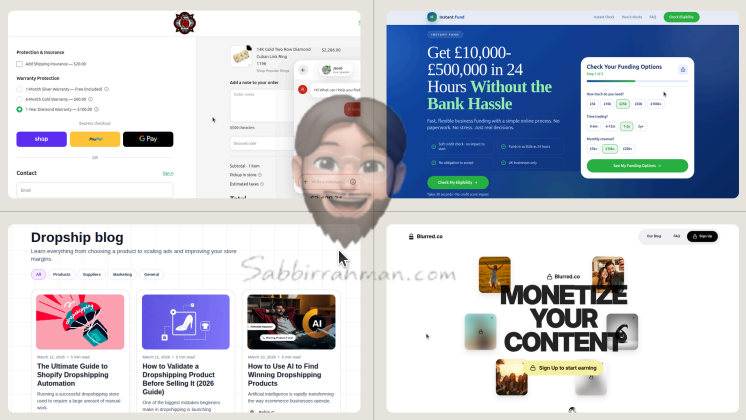
Droplink is useful proof from the acquisition side of SaaS. It was built as a multilingual growth layer for a dropshipping SaaS so the website could do real work: attract customers, build trust, explain pricing, support localized intent, and move visitors cleanly into signup flows. Funding Frank shows the same commercial thinking in a different vertical, where the product had to qualify leads fast and hand them off in a lender-ready structure instead of just collecting form submissions.
QuickHire at a glance
- UK geolocation-based hiring marketplace built around a clear operational workflow instead of generic marketplace filler.
- Job posting, applications, company profiles, and tracking features structured as a coherent product journey.
- Monetization-ready backend designed for subscriptions, credit unlocks, and growth beyond an MVP launch.
- Built with React, Node.js, and PostgreSQL to balance delivery speed with long-term extensibility.
Browse shipped work
See the broader project archive for marketplaces, internal tools, ecommerce builds, and operations systems.
Read the QuickHire case study
Open the project detail page for the UK hiring marketplace used as proof throughout this page.
See Droplink
A SaaS acquisition engine built to attract customers, strengthen trust, support multilingual discovery, and turn traffic into cleaner signup flows.
See Funding Frank
A lead-generation and qualification product that improved handoff quality by structuring higher-intent enquiries for downstream sales and lender workflows.
Why Choose Me
Why founders bring me into SaaS builds
Founders usually need more than raw implementation capacity. They need someone who can keep one eye on the code and the other on whether the product is becoming easier or harder to operate. That is especially true in early-stage SaaS work, where the wrong technical shortcut can silently tax every future release.
I like working close to that tension. It keeps the engineering honest. If a better result comes from reducing scope, changing the order of delivery, or preparing a feature for monetization before it is visually perfect, I am comfortable making that call and explaining why.
That approach tends to work well for lean teams because it treats engineering as part of product strategy, not as a downstream service. A founder should be able to understand why a build decision matters, what it unlocks later, and what risk it avoids now. I try to make that connection visible throughout the project.
I understand the founder context
The product has to move, but it also has to make business sense. I keep the conversation tied to user value, scope risk, and what each build decision means for the next stage of growth.
I can own the full stack without losing product clarity
Frontend quality, backend logic, database design, and deployment all affect the product experience. I work across that chain so one part of the system does not quietly sabotage another.
I optimize for usable software, not demo polish
A good MVP should feel coherent under real usage. That means thoughtful edge cases, sensible feedback states, and operational logic that does not collapse when the first customers arrive.
I build for the next release too
If the product works today but becomes hard to extend tomorrow, the build was not really successful. I care about keeping future iteration affordable.
FAQ
Questions about SaaS product development
Founders usually ask these questions when they are trying to get an MVP live without building the wrong thing or creating technical debt that slows the next stage.
Can you help define the MVP before development starts?
Yes. I usually help narrow the product around the first valuable workflow, map the core entities and permissions, and decide what should ship now versus wait until after initial validation.
What kinds of SaaS features do you typically build?
Common work includes onboarding flows, dashboards, admin panels, roles and permissions, subscription-ready backends, billing-related workflows, reporting, and operational tools.
How do you avoid overbuilding a SaaS MVP?
I keep the scope tied to the business question the first release needs to answer, then build the backend and UI with enough structure that later iterations stay affordable.
Call To Action
Planning to build a SaaS product or MVP?
If you want a SaaS developer who can help scope the product, shape the architecture, and ship a clean first version, we can talk through the user flow, the release scope, and the fastest credible build path.
The best SaaS products do not start as giant platforms. They start as focused systems built with enough discipline to grow.